Project 4- Enterprise Security & ISO 27001 Readiness for a Scaled-Up Company in Germany
(Relevant to Governance & Compliance Kit)
PROJECTS
Introduction
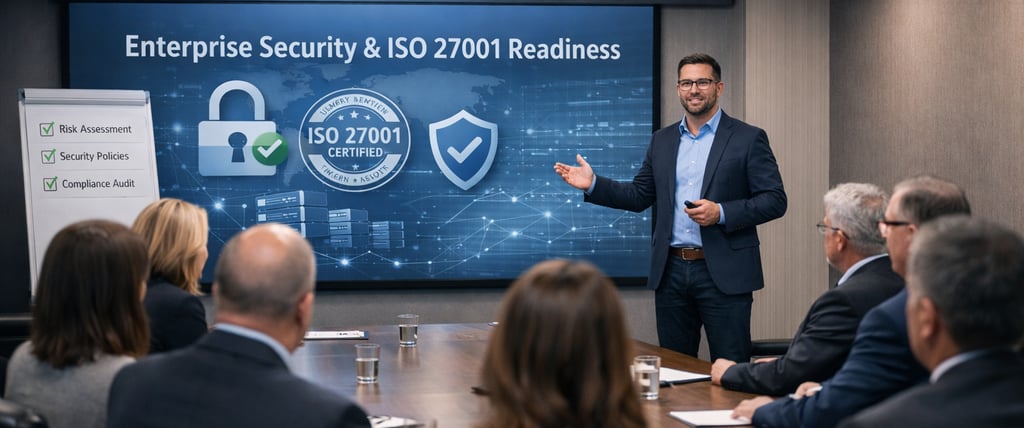
A fast-growing technology company with 500+ employees was preparing for enterprise clients and regulatory scrutiny. To support international expansion and meet customer security expectations, the leadership team committed to achieving ISO/IEC 27001 certification. While the company had strong engineering capabilities, security governance, documentation, and controls had evolved organically and lacked the structure required for a formal audit.
Challenges
The organization faced several challenges common at this scale:
• No centralized Information Security Management System (ISMS)
• Security controls existed but were inconsistently applied across teams
• Limited documentation for policies, risk assessments, and procedures
• Unclear ownership of security responsibilities across departments
• Gaps in access management, vendor risk, and incident response processes
The leadership team needed clarity on readiness, a realistic remediation plan, and guidance to avoid overengineering while still meeting ISO requirements.
Solution
We conducted a full ISO 27001 readiness assessment, aligned with Annex A controls and ISO best practices.
Key actions included:
• Assessing current infrastructure, SaaS landscape, and access controls
• Mapping existing practices against ISO 27001 requirements
• Identifying gaps and prioritizing remediation efforts
• Defining a pragmatic ISMS structure tailored to the company’s scale
• Supporting the creation of security policies, risk registers, and SOPs
• Preparing teams for audit expectations and evidence collection
Throughout the engagement, the focus remained on practical compliance, not checkbox security.
Impact
Within the planned audit timeline, the company:
• Achieved ISO/IEC 27001 certification
• Established a clear, auditable security governance model
• Improved ownership and accountability across IT and security functions
• Strengthened customer and enterprise partner trust
• Created a scalable security foundation for future regulatory requirements
The organization transitioned from reactive security practices to a structured, enterprise-ready security posture without disrupting day-to-day operations.