Project 6- IT M&A Integration for a High-Growth Startup in Germany
(Relevant to IT M&A Integration Kit)
PROJECTS
Introduction
A fast-growing startup experienced rapid market success that attracted strong investor interest and led to the acquisition of several smaller, complementary businesses. While the commercial rationale for the mergers was clear, leadership quickly recognized that integrating multiple IT environments posed a significant operational and security risk. Zotech Advisory was engaged to lead the IT M&A integration strategy and execution, ensuring continuity, cost control, and long-term scalability.
Challenges
Each acquired company operated with its own tools, vendors, access models, and hardware standards. SaaS applications overlapped across organizations, licensing costs were unclear, and ownership of systems varied widely. There was no unified governance model, no standardized onboarding or offboarding process, and limited visibility into security posture and data access across the merged entities. From a leadership perspective, the risk was twofold: operational disruption during integration and the introduction of hidden security, compliance, and cost liabilities. The business needed to integrate quickly without slowing growth or impacting day-to-day operations.
Solution
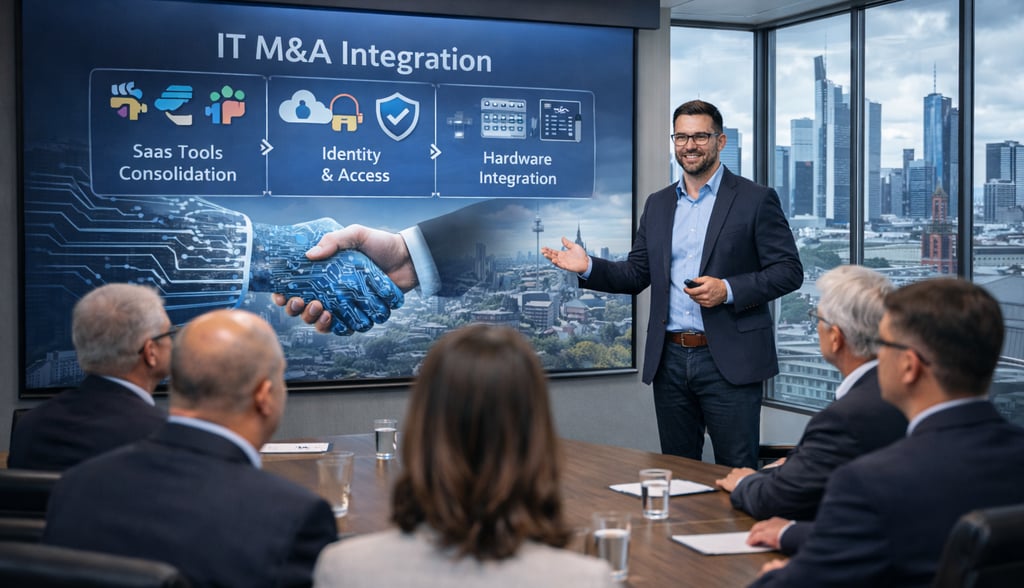
Zotech Advisory led a structured IT M&A integration program focused on clarity, control, and speed. We began with a full assessment of both organizations’ IT landscapes, including SaaS tools, infrastructure, identity systems, hardware assets, contracts, and security controls. Based on this assessment, we defined a target-state IT architecture and governance model. Redundant and non-strategic tools were identified and phased out, while critical platforms were consolidated under a single ownership and operating model. Licensing structures were optimized, and vendor contracts were reviewed to reduce duplication and renegotiate costs. We designed and executed a secure identity and access integration, ensuring acquired employees were onboarded into the parent company’s systems with appropriate permissions and controls. Hardware assets were inventoried, standardized, and brought under centralized device management. Clear IT policies, access rules, and operational procedures were established to align all teams under a single operating framework.
Impact
The integration was completed without disrupting business operations or growth momentum. The company gained full visibility into its combined IT environment, significantly reduced software and licensing costs, and eliminated redundant tools and vendors. Security posture improved through standardized access management, clearer ownership, and documented governance processes. Leadership gained confidence that future acquisitions could be integrated efficiently using a repeatable, well-defined IT M&A playbook. Most importantly, IT shifted from being a post-merger risk to a strategic enabler, supporting scalability, investor confidence, and long-term operational resilience.